 Freedom Calcs
Retirement planning
What Is Barista FIRE? Meaning, Numbers, and How It Differs From Coast FIRE
Barista FIRE means covering part of your expenses with part-time work while your portfolio funds the rest. See the meaning, the math, and how it differs from Coast FIRE.
The short answer
Barista FIRE means paying part of your living expenses with part-time work and drawing from your investments to cover the rest. The paycheck lets you draw less while you work. Once it stops, you need a plan for covering the full bill.
Use the Barista FIRE calculator to estimate what you would need for both stages.
Barista FIRE Meaning in One Sentence
Barista FIRE is a form of semi-retirement in which pay from work covers part of your budget and investments cover the remaining expenses. FIRE stands for Financial Independence, Retire Early. In this version, you still count on a paycheck. The question is how much less you need to earn for your savings to support the change.
A common story links the name to taking part-time shifts at a coffee shop such as Starbucks for pay and possibly health insurance. Treat that as an illustration of the idea, rather than a documented origin or a promise about any employer’s benefits. The work could be tutoring, bookkeeping, or consulting for a few regular clients. What matters for the math is how much of your budget the pay covers and when that pay might stop.
How Barista FIRE Works: Two Stages
While you earn: The portfolio covers the monthly gap
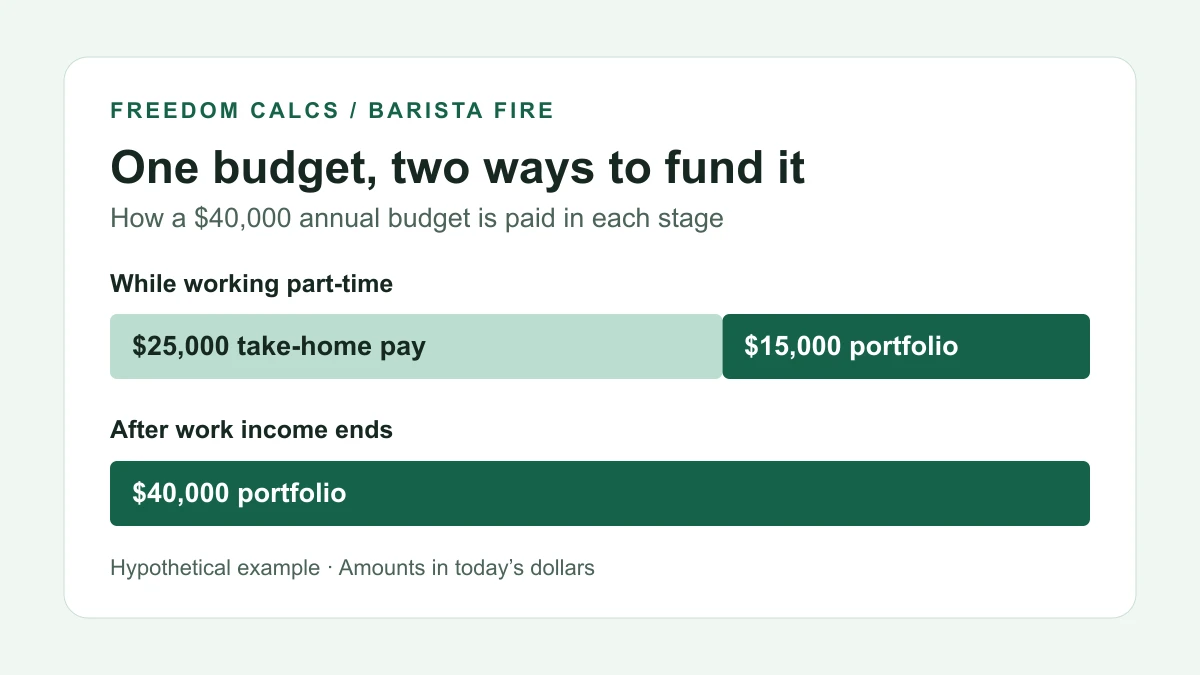
Start with the budget you expect on a reduced schedule. If living costs are $40,000 a year and you bring home $25,000 from work, your investments need to supply $15,000 a year, or $1,250 a month. Our model starts the income period now. It grows the portfolio at the assumed monthly rate and deducts the gap at the end of each month.
Pay and spending stay constant in purchasing power. If pay covers every expense, the modeled withdrawal is zero. If pay exceeds expenses, the model still assumes zero new contributions. An extra $300 a month is useful in real life, but the tool does not add that money to the balance.
After work ends: The portfolio covers the full budget
When the last paycheck stops, the same $40,000 budget now calls for $40,000 a year from investments. At an assumed 4% initial withdrawal rate, the target on that transition date is $1 million. The model calculates the balance you need today to make every bridge withdrawal and still reach that target.
A Coast FIRE calculation discounts the later target while leaving the portfolio untouched. If you take $1,250 a month from the portfolio along the way, Coast math leaves those withdrawals out. The gap you fund today and the balance you need at the end are separate costs.
If work covers all your living costs until retirement, the Coast FIRE Calculator can estimate the balance you need invested today to let it grow without new contributions or withdrawals.
Barista FIRE vs Coast FIRE vs Lean FIRE vs Fat FIRE
| Approach | Goal | Withdraw now? | Role of work income | Portfolio balance needed |
|---|---|---|---|---|
| Barista FIRE | Step back from full-time work | Yes, if pay falls short | Covers part of the current budget | Funds bridge withdrawals and the later target |
| Coast FIRE | Let existing savings grow toward a later retirement | No, during the coast period | Work or other resources cover current expenses | Later target discounted to today, with no bridge withdrawals |
| Lean FIRE | Fund retirement on a lower spending budget | When portfolio-funded retirement starts | Optional once the budget is fully funded | Portfolio-funded spending divided by the chosen rate |
| Fat FIRE | Fund retirement with a larger spending budget | When portfolio-funded retirement starts | Optional once the budget is fully funded | Same calculation, applied to a larger budget |
Coast FIRE is a savings milestone: can the money you already have grow to your retirement target? Lean FIRE and Fat FIRE describe how much you plan to spend. Barista FIRE describes how you pay the bills, so you can use a Barista bridge with either a lean or a larger budget.
How to Calculate Your Barista FIRE Number
First calculate the full FIRE number you will need after work ends. Divide the annual amount the portfolio must supply by your assumed initial withdrawal rate. Then discount that target to today and add the present value of the monthly gaps between now and then.
Monthly gap = max(annual spending − annual take-home pay, 0) ÷ 12
Full target = annual spending ÷ initial withdrawal rate
Real annual return = (1 + nominal return) ÷ (1 + inflation) − 1
Monthly real return = (1 + real annual return)^(1/12) − 1
Required today = present value of monthly gaps + present value of full target
For each gap, divide the payment by (1 + monthly real return)^m, where m is the month the payment comes due. Add those amounts. Then divide the full target by the same growth factor raised to the number of bridge months. If the real return is zero, add the undiscounted gaps to the full target. The Federal Reserve Bank of St. Louis explains the nominal-to-real conversion.
For a quick check, imagine income lasts five years and growth exactly matches inflation. Sixty withdrawals at $1,250 cost $75,000 in today’s dollars, and the later target is $40,000 ÷ 0.04 = $1 million. With no real growth to help pay for either, the starting target is $1,075,000. Notice that this exceeds the full target. A bridge with withdrawals does not automatically make a plan cheaper.
A Reproducible Example
Imagine you are 35 and want to move to part-time work now, with the last paycheck at age 45. You spend $40,000 a year and expect to bring home $25,000 a year for ten years. Assume a 7% nominal annual return, 3% inflation, and a 4% initial withdrawal rate after work ends. All amounts below are in today’s dollars, and the example is hypothetical.
Open the Barista FIRE calculator and enter $40,000 for Annual living costs, $25,000 for Annual take-home work income, and 10 for Years of part-time income. Enter 7%, 3%, and 4% in the return, inflation, and withdrawal fields. There is no age field; age 35 makes the timeline concrete, while the ten years determine the discounting. To see how a current balance compares, enter $500,000 under Current invested assets and open View annual projection data. That input changes the projection and the savings gap, not the required starting target.
| Calculation | Result |
|---|---|
| Monthly gap: ($40,000 − $25,000) ÷ 12 | $1,250 |
| Annual real return: 1.07 ÷ 1.03 − 1 | 3.8835% |
| Monthly real return: (1.07 ÷ 1.03)^(1/12) − 1 | 0.3180% |
| Target at age 45: $40,000 ÷ 0.04 | $1,000,000 |
| Present value of 120 monthly gaps | $124,535 |
| Present value of $1 million due at age 45 | $683,179 |
| Required portfolio at age 35 | $807,714 |
The tool’s ongoing-income comparison is $375,000: $15,000 ÷ 0.04. That figure assumes the $25,000 keeps coming throughout the spending plan. Once it stops, the portfolio must replace it. The $807,714 estimate includes both stages; $375,000 prices only the smaller ongoing need.
Why Income Duration Matters
Change only the income duration. At 35, five years of work takes you to 40; ten years takes you to 45. The later target stays at $1 million in today’s dollars.
| Years of part-time income | Required portfolio today |
|---|---|
| 5 years | $894,727 |
| 10 years | $807,714 |
Five years less work income raises the starting target by $87,013 in this example. The shorter bridge actually has fewer gap withdrawals. But it also brings the $1 million target five years closer, and that effect is bigger. With zero real growth and the same monthly gap, the direction reverses: ten years of gaps cost more than five, while the later target receives no discount in either case.
If a job lasts only five years, the first row assumes the full budget shifts to the portfolio at age 40. If instead you expect a break in work and then a return to paid work, model the missed pay separately. A single end date does not capture alternating months with and without a paycheck.
The size of the gap matters as much as the end date. If your take-home pay falls by $5,000 a year and nothing else changes, the monthly withdrawal rises by about $417. Over ten years at the same return, those extra payments add about $41,512 to the starting target. The $1 million target at the end is unchanged. This is why it helps to compare a realistic low-pay scenario with your base case before deciding how far to cut back.
What Barista FIRE Does Not Mean
- A part-time offer makes the plan safe. Base the income input on hours and pay you can reasonably expect. A good month or a contract with no promised hours can overstate the amount available for rent and groceries.
- Your investments can already cover the full budget. In the example, the portfolio covers $15,000 a year while you work. The other $25,000 still has to come from somewhere.
- Health insurance and interruptions take care of themselves. Check the hours needed for any employer plan and the costs if you lose it. HealthCare.gov explains Marketplace options for people who retire before 65 and lose job-based coverage. Price coverage for your household before counting on a lower work schedule.
- Markets will deliver the assumed return every month. Early losses can matter when you are selling to pay bills: fewer assets remain to participate in a recovery. A steady 7% nominal assumption cannot show that path. Test a lower real return and a shorter period of work to see how much the estimate moves.
Who Barista FIRE Fits and Who It Doesn’t
Consider it if you can picture working another five to fifteen years on fewer hours, would willingly trade some pay for time, and have skills that employers or clients will pay for on that schedule. Five to fifteen years is a scenario to test, not a cutoff. Someone who can keep two dependable clients after leaving a salaried role has a different income outlook from someone who needs to find a new job every season.
It is a harder fit if hours fluctuate, your household relies on coverage tied to your current job, or part-time pay leaves most expenses to the portfolio. Before changing hours, look at the budget you could keep through a slow year. Check which accounts can actually fund monthly withdrawals, how much coverage would cost, and which bills you could cut if income stopped. An investment balance and money available to spend this month are different things.
FAQ
How much do you need for Barista FIRE?
You need enough to fund the gap while you work and still have the full portfolio target when work ends. Use the Barista FIRE calculator to vary your take-home pay, work years, and spending. A smaller paycheck or lower assumed growth can materially raise the estimate.
Is Barista FIRE the same as Coast FIRE?
No. In the Coast model, other resources pay current bills and the retirement portfolio stays invested without withdrawals. In the Barista model, you may draw from the portfolio now to cover the part of the budget your pay leaves unfunded.
What is the difference between Barista FIRE and Lean FIRE?
Lean FIRE describes retiring on a lower budget. Barista FIRE describes using work income alongside investments. A low budget can make the work-income gap smaller, so the two ideas can apply to the same plan.
Can you Barista FIRE with $500,000?
It depends on the budget and how long you can earn. In the ten-year example, $500,000 projects to about $549,585 at age 45 after the monthly draws, short of the $1 million target. The balance survives the bridge in that illustration, but it falls short at the point when the paychecks stop.
Does part-time income delay FIRE?
It depends on what you compare. Stepping down from a higher-paying job may slow savings and move full financial independence later. Compared with stopping work entirely on the same date, some take-home pay reduces the amount you need to draw during the bridge. Compare both scenarios from the same starting balance and include any contributions you would give up.
Is Barista FIRE worth it?
The trade is time now in exchange for continued reliance on work income. Compare the hours you gain with the wages, savings contributions, and benefits you give up. A trial budget on the lower take-home amount can show which expenses need to change before you commit.
Sources and Model Notes
The example follows the Freedom Calcs methodology: fixed real spending and pay, constant real monthly growth, month-end withdrawals, and no contributions. The estimate stops at the end of work. It checks the balance against the later target and does not project the years of withdrawals that follow. It does not model taxes or fees separately, benefit eligibility, changing pay or costs, or the chance that the portfolio lasts. Include relevant costs in your inputs or assess them separately.
William Bengen’s account of his historical withdrawal research explains the background to the 4% assumption. Our guide to the 4 percent rule explains how the initial rate translates a budget into a portfolio target and why the historical results do not establish a safe rate for your retirement. Here 4% sets the later target; the bridge withdrawals come from the monthly budget gap.
Sources & further reading
- Federal Reserve Bank of St. Louis: constructing real interest rates
Explains how to convert nominal rates to real rates. It does not supply the portfolio return assumption.
- William P. Bengen: background on the 4% rule
The researcher describes the original historical analysis and its time horizon. The Barista bridge calculation is separate.
- HealthCare.gov: health coverage for retirees
Explains Marketplace options for people who retire before 65 and lose job-based coverage.