 Freedom Calcs
Withdrawal assumptions
4 Percent Rule: How It Works & How to Test Your Number
The 4 percent rule starts with 4% of your portfolio, then adjusts withdrawals for inflation. See the math, limits, and how to test your number.

The short answer
The 4 percent rule starts retirement withdrawals at 4% of your initial invested portfolio, then adjusts that dollar amount for inflation each year. A $1 million portfolio starts at $40,000. It is a planning guideline drawn from historical research, with assumptions that may not fit your retirement.
Use the rule to translate a retirement budget into a starting portfolio target. Then check the assumptions behind that target: how long withdrawals must last, what costs come out of the account, and how much spending could change after a bad market year.
What is the 4 percent rule? Start with the formula
The familiar calculation has two directions. One estimates the first year’s withdrawal from a portfolio you already have. The other works backward from the annual spending that investments must cover.
First-year withdrawal = starting portfolio × 0.04
Target portfolio = annual portfolio-funded spending ÷ 0.04
                 = annual portfolio-funded spending × 25
For example, $1,250,000 × 0.04 gives a $50,000 first-year withdrawal. Reversing the calculation, $50,000 ÷ 0.04 gives the same $1,250,000 target. These are gross portfolio withdrawals: taxes and investment costs still need to be handled in the plan.
In later years, the traditional version adjusts the original dollar withdrawal for inflation. With an assumed 3% increase, year two becomes $51,500. It does not automatically become 4% of whatever the account is worth that year. Withdrawing a fixed percentage of the current balance is a different strategy, with income that rises and falls with markets.
The rule also does not promise a 4% investment yield. Withdrawals can come from dividends, interest and selling investments, including principal. It is a spending policy applied to a diversified portfolio, rather than an instruction to find an account paying exactly 4%.
Where it came from: Bengen and the Trinity study
William Bengen’s 1994 original paper, published in the Journal of Financial Planning, examined historical US stock and intermediate-term Treasury returns. He looked at how different starting withdrawals, subsequent inflation adjustments and asset allocations affected portfolio longevity.
He tested difficult retirement starting dates. A long-run average return could conceal the damage from an early market decline followed by inflation. His analysis supported a roughly 4% initial withdrawal for a retirement planning horizon of at least 30 years within the historical conditions examined. The starting withdrawal was a percentage of initial assets; later dollar withdrawals followed inflation.
That finding was conditional on the investments and withdrawal method used. It was not evidence that cash, a concentrated stock position or every future portfolio could support the same spending.
The 1998 Trinity study by Philip Cooley, Carl Hubbard and Daniel Walz examined US returns from 1926 through 1995, five stock/bond mixes and withdrawal periods of 15, 20, 25 and 30 years. Stocks were represented by the S&P 500 and bonds by long-term, high-grade corporate bonds. Those bond assumptions differ from Bengen’s.
It reported how often portfolios finished historical payout periods with money remaining, examining both nominal and inflation-adjusted withdrawals. Taxes and transaction costs were not included. An ending balance above zero counted as success; preserving the original principal was a separate question.
These studies helped turn a spending problem into something investors could test. Their historical success figures describe overlapping past periods, not independent forecasts of your retirement or a contractual promise that withdrawals will continue.
The 25-times rule: match spending to a portfolio
At a 4% starting withdrawal, each $1 of annual portfolio-funded spending requires $25 of investments. Use the spending that must actually come from this portfolio, in a consistent purchasing-power basis.
| Annual portfolio-funded spending | Portfolio at 4% |
|---|---|
| $30,000 | $750,000 |
| $40,000 | $1,000,000 |
| $50,000 | $1,250,000 |
| $60,000 | $1,500,000 |
| $80,000 | $2,000,000 |
| $100,000 | $2,500,000 |
For a hypothetical household spending $60,000 a year with $20,000 of reliable continuing income, the gap is $40,000. At 4%, that gap implies a $1 million target. Match gross or net amounts carefully: a gross pension figure does not necessarily offset the same amount of after-tax living expenses.
Timing matters too. If that income begins in ten years, it does not fund the first ten years of retirement. A single subtraction cannot describe both periods. Allow for the bridge before benefits begin, their purchasing power and any change after a partner dies.
The table is a lookup tool, not a list of adequate retirement balances. For $40,000 of spending, using 3.5% instead implies about $1,142,857; 3% implies about $1,333,333. Those larger targets illustrate sensitivity to the assumption. They do not establish that either lower rate will work for your investments or lifespan.
Where the retirement 4 percent rule can break
1. The same returns can arrive in a damaging order
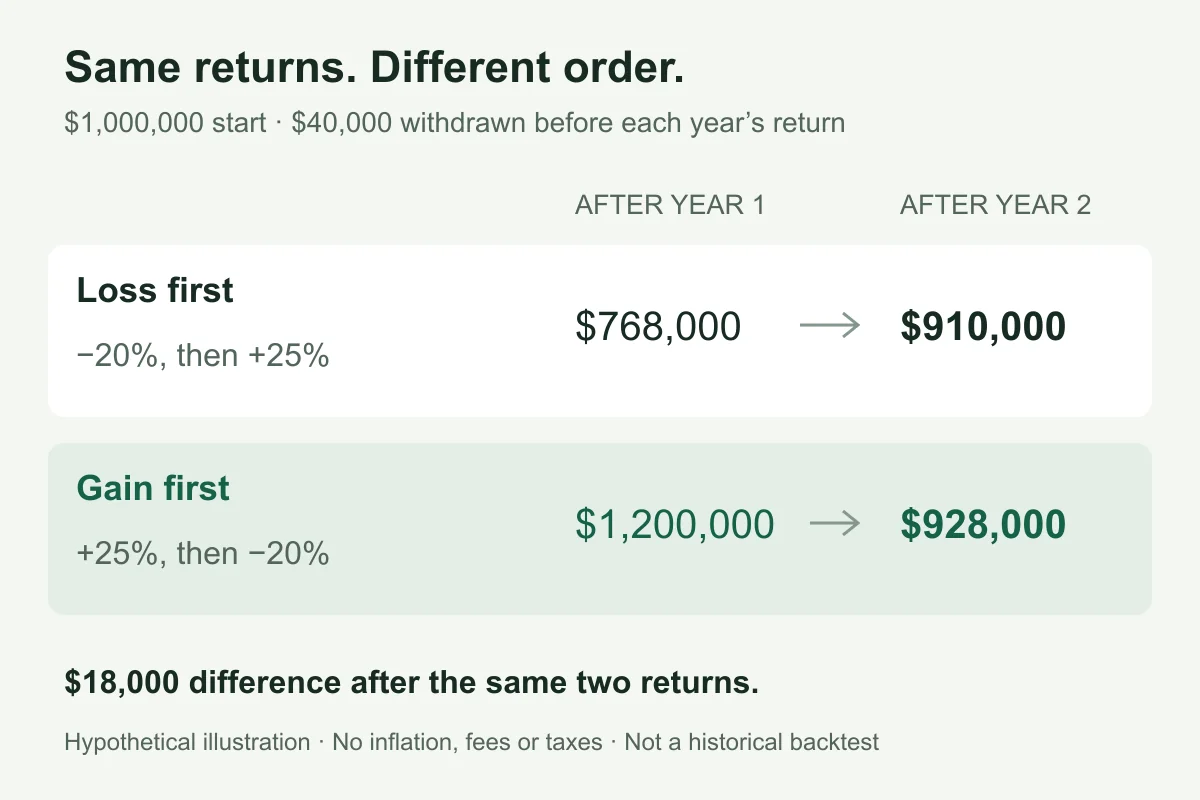
Consider two hypothetical retirees with $1 million each. Both withdraw $40,000 at the start of each year, with no inflation, fees or taxes. One experiences returns of −20%, then +25%; the other gets +25%, then −20%.
Loss first: ($1,000,000 − $40,000) × 0.80 = $768,000
            ($768,000 − $40,000) × 1.25 = $910,000
Gain first: ($1,000,000 − $40,000) × 1.25 = $1,200,000
            ($1,200,000 − $40,000) × 0.80 = $928,000
The two return sequences have the same 2.5% arithmetic average and the same cumulative return before withdrawals: zero. Yet ending balances differ by $18,000. Early losses leave less capital to recover while living expenses continue. Two years demonstrate the mechanism; this example is not a retirement forecast or historical backtest.
2. Fees use money that could otherwise stay invested
A 1% annual charge on a $1 million starting balance is initially $10,000. Alongside $40,000 of living-cost withdrawals, that is roughly $50,000 leaving the portfolio before considering market changes. The SEC explains how investment fees reduce returns.
For scale, a separate $1 million balance growing at an assumed constant 5% for 20 years becomes about $2,653,298 before withdrawals. With a fee equal to 1% of each year’s post-growth balance, annual net growth is 1.05 × 0.99 − 1, or 3.95%, leaving about $2,170,151. This simplified fee-only comparison is not a retirement withdrawal simulation.
3. Inflation changes the dollar withdrawal
At constant assumed 3% inflation, a $40,000 first-year withdrawal rises to about $52,191 in year ten: $40,000 × 1.03^9. At 6%, it becomes about $67,579. Both maintain purchasing power under their respective assumptions, but require different nominal amounts from investments.
The BLS CPI guidance explains why a household’s experience can differ from an aggregate index. A rent increase or care bill may outrun the adjustment you modeled. The original rule accounts for inflation; an unusually difficult inflation path can still strain the portfolio.
4. Your retirement can outlast the test period
Retiring at 65 and planning through 95 means 30 years. Retiring at 45 with the same endpoint means 50. $1 million funding $40,000 annually with zero real return lasts 25 years, ignoring fees and taxes. Investment returns must do work beyond that.
Vanguard’s discussion of FIRE and the 4% rule addresses the longer horizon faced by early retirees. A plan for one person must also consider a surviving partner’s spending and late-life care, rather than ending at the first household death.
What more recent research says about the 4 percent rule for retirement
Bengen’s subsequent work uses broader investment mixes. His September 2025 research note describes the 4.7% framing around a 55% stock, 40% bond and 5% cash allocation, then compares a higher stock allocation. That is a materially different portfolio experiment from the original simplified rule. It does not authorize every retiree to raise spending by the same percentage.
Morningstar takes a forward-looking approach. Its guidance for new retirees in 2025 put the base starting rate at 3.7%. The report published December 3, 2025 raised that to 3.9%, using a 30-year horizon, inflation-adjusted spending and a 90% modeled probability of funds remaining. Its highest base-case rates came from 30% to 50% equity allocations. The report also tested flexible spending methods; their higher starting withdrawals came with changes in future spending.
A valuation-informed approach asks whether the starting market is unusually expensive. Michael Kitces’s CAPE analysis discusses using long-run stock valuations to inform initial spending. CAPE compares price with ten years of inflation-adjusted earnings; it is not a reliable short-term trading signal. Valuation-linked rules can also change spending over time, which exposes households to income cuts.
The disagreement reflects different questions: historical worst-case experience versus forecasts, different allocations, and fixed purchasing power versus flexible spending. Compare those assumptions before comparing percentages. A useful personal test asks what a lower starting withdrawal or a spending cut would mean for your actual budget. None of these research approaches removes the need to revisit the plan.
What 4% means for your type of FIRE
FIRE labels describe budgets or income arrangements; they do not assign you a scientifically established withdrawal percentage. You can use 4% as an editable starting assumption across several approaches, but the timing and amount of portfolio withdrawals differ.
| Approach | What the withdrawal assumption does | Calculator |
|---|---|---|
| Standard FIRE, including a higher-spending Fat FIRE budget | Converts portfolio-funded annual spending into a full target. A larger budget does not justify a higher rate. | FIRE Number Calculator and worked example; Fat FIRE Calculator |
| Coast FIRE | Sets the future retirement target. Assets grow toward it while other income funds current bills; the coasting period assumes no portfolio withdrawals. | Coast FIRE Calculator |
| Lean FIRE | Applies the chosen rate to a lower budget. Limited room to cut essential costs may make spending adjustments harder. | Lean FIRE Calculator |
| Barista FIRE | Part-time income reduces the current spending gap. The plan must also cover the period after that income ends. | Barista FIRE Calculator |
For the savings milestone and its assumptions, see Coast FIRE meaning and how to know your number. Reaching a Coast target does not establish that a future withdrawal plan will succeed.
Keep spending and continuing income in today’s dollars when using these tools. They help check target arithmetic and, where applicable, growth or an income bridge. They do not simulate a retirement’s actual sequence of investment returns, taxes or withdrawals. Review those missing pieces before making a retirement decision.
Test your own number
Start with annual spending that your portfolio needs to cover. For a $60,000 budget and $20,000 of continuing income available immediately throughout the modeled period, enter those amounts and a 4% withdrawal assumption. The result is $1 million.
Then change only the rate to 3.5% and 3%. The targets become approximately $1,142,857 and $1,333,333. Return to the worked-example row in the comparison table to open the calculator’s own example and check its assumptions.
Ask whether your budget includes taxes, recurring fees and irregular expenses, and whether the assumed income lasts as long as withdrawals do. The calculator shows how the chosen rate changes a target; it does not select a suitable rate or estimate your probability of success.
Frequently asked questions
Does the 4 percent rule include inflation?
Yes. The original approach sets the first withdrawal from the starting portfolio, then adjusts that dollar amount for inflation. At 3% inflation, $40,000 becomes $41,200 in year two. Your household costs can differ from a broad inflation index, so keep reviewing the actual budget.
Will a 4% withdrawal last for 30 years?
It lasted through the historical periods and portfolio assumptions behind particular studies; that cannot guarantee your next 30 years. Returns, allocation, inflation, costs and spending all affect the outcome. A target calculator only divides spending by a rate. It does not test whether your money lasts.
Can I use the 4 percent retirement rule after withdrawals have already started?
You can use it as a reference, but distinguish your original withdrawal plan from a fresh calculation on today's balance. Reapplying 4% annually creates a different spending strategy. Review your remaining horizon, current assets and spending needs before changing course; a new headline research estimate is not an automatic reset instruction.
Are 4% and the 25-times rule the same thing?
They are the same arithmetic in opposite directions: 1 divided by 0.04 equals 25. Spending $50,000 a year implies $1.25 million at 4%. The multiplier does not establish an investment return, a probability of success or how many years the portfolio will last after withdrawals begin.
What if my funds and adviser charge high fees?
List fund expenses, advice fees and account charges, and identify which are already reflected in reported returns. A 1% annual charge on $1 million is initially $10,000, alongside any living-cost withdrawal. Avoid subtracting fees twice. Lower costs can help, but they do not make a particular withdrawal percentage certain.
Does the 4 percent rule for retirement work if I retire early?
A retirement beginning at 45 can require 50 years of spending through age 95, well beyond a 30-year illustration. Test a longer horizon, lower starting rates and spending adjustments, including healthcare and account-access constraints. Early retirement does not come with a separate universally correct percentage simply because you call it FIRE.
Sources & further reading
- William P. Bengen: Determining Withdrawal Rates Using Historical Data (1994)
Original Journal of Financial Planning article, linked from the author's research directory. Historical US results and specified allocations are not future guarantees.
- Cooley, Hubbard, and Walz: Retirement Savings—Choosing a Withdrawal Rate That Is Sustainable (1998)
Author-hosted original Trinity study; distinguishes nominal and inflation-adjusted withdrawals, historical success and forecast uncertainty.
- William P. Bengen: Optimizing Fixed Asset Allocation During Retirement (September 18, 2025)
Author's subsequent research describes the 4.7% framing with different stock, bond and cash allocations. It is not an across-the-board revision for every portfolio.
- Morningstar: The State of Retirement Income, 2025 (December 3, 2025)
Original report: 3.9% base case, 30-year horizon, 90% modeled success and forward-looking assumptions; also explains how existing retirees should use the research.
- Morningstar: What's a Safe Retirement Spending Rate for 2025?
Documents the earlier 3.7% starting-rate estimate; included to keep the research year and retirement starting year distinct.
- Michael Kitces: Shiller CAPE Market Valuation and Long-Term Retirement Planning (2014)
Author's analysis of valuation-informed initial spending; distinguishes long-horizon planning from short-term market timing.
- SEC Investor.gov: How Fees and Expenses Affect Your Investment Portfolio (2025)
Official explanation of investment cost drag and the disclosures investors can inspect. Our fee examples are separate hypothetical arithmetic.
- US Bureau of Labor Statistics: Consumer Price Index Questions and Answers
Explains CPI and why household inflation can differ from the aggregate measure. The 3% and 6% examples here are assumptions.
- Vanguard: FIRE Investing and the 4% Rule for Early Retirement
Discusses how early retirement and spending flexibility change the application of the rule; it does not validate our calculators.