 Freedom Calcs
Coast FIRE
What Is Coast FIRE? Meaning, Numbers, and How to Calculate It
Coast FIRE means your investments can reach your retirement target without more contributions, if assumptions hold. Learn the meaning and calculate your number.
The short answer
Coast FIRE means having enough invested today that, under your chosen growth and spending assumptions, those investments could reach your retirement target without further retirement contributions. You still need income or other resources to cover living costs until retirement.
Coast FIRE is a retirement savings milestone: your existing investments could grow to fund a later retirement without more contributions, if your assumptions hold. It does not mean that those investments can cover your bills today. Work or other resources still need to fund the years before retirement.
The amount depends on your spending, time horizon, and assumed growth. This guide uses the same purchasing-power convention as our calculator, so you can reproduce the examples and see how changing one input changes the answer.
Coast FIRE Meaning in One Sentence
Coast FIRE means reaching the investment balance that could grow into your future retirement target without additional retirement savings. Traditional FIRE generally refers to having the full portfolio needed to support financial independence when withdrawals begin.
FIRE stands for Financial Independence, Retire Early. You may also see Coast FI, emphasizing financial independence rather than an early retirement date. Someone can reach Coast FI while planning to work until 65. The label describes the funding arrangement; it does not set a universal retirement age or dollar amount.
What does Coast FIRE mean for everyday life? Under a workable plan, it can make retirement saving less dependent on future paychecks. Current living costs still need funding, and continuing to save can add a cushion. Reaching the mathematical threshold alone is not a reason to stop contributions.
How Coast FIRE Works
The model starts with a future retirement asset target and works backward. With positive growth after inflation, investments have more time to compound when retirement is farther away, so the required balance today is smaller. At the retirement date, there is no growth period left and the Coast threshold equals the full target.
Our model uses today’s dollars throughout. A 7% nominal return with 3% inflation becomes a real annual return of about 3.8835%, using (1.07 / 1.03) - 1. The Federal Reserve Bank of St. Louis explains this exact conversion. Subtracting 3% from 7% gives a convenient approximation, but the calculator uses the ratio.
The projection assumes constant returns and inflation, no withdrawals before retirement, and a fixed spending target in purchasing-power terms. Actual investments fluctuate. With zero real growth, the current threshold equals the future target; with negative real growth, it can exceed it. More time only reduces the threshold when assumed real growth is positive.
Coast FIRE vs FIRE, Barista FIRE, and Lean FIRE
These terms describe different parts of a retirement plan. Coast FIRE describes a savings milestone, Barista FIRE describes a mix of income sources, and Lean FIRE describes a spending budget.
| Approach | Goal | Portfolio withdrawals now | Role of work income | Required balance |
|---|---|---|---|---|
| Coast FIRE | Fund a later retirement through growth | None during the coasting period | Covers current living costs | Future target discounted over the years remaining |
| Traditional FIRE | Fund financial independence when retirement starts | Usually begin at retirement | Living costs need not depend on wages | Full portfolio-funded spending target |
| Barista FIRE | Combine work income and investments | May cover a current spending gap | Pays part of current expenses | Funds both the income bridge and the period after work ends |
| Lean FIRE | Fund retirement on a lower spending budget | Begin when portfolio-funded retirement starts | Depends on the plan | Full target for that lower budget |
If work income falls below living costs and you withdraw from investments to cover the difference, a simple Coast calculation omits those withdrawals. The Barista FIRE Calculator models a limited work-income period and the full spending target afterward.
Use the Lean FIRE Calculator to explore a smaller budget or the Fat FIRE Calculator for a higher spending target. A person can be coasting toward either budget. Neither label establishes an amount that is safe for everyone.
How to Calculate Your Coast FIRE Number
First estimate the annual spending your portfolio must support in retirement. Include costs such as taxes, healthcare, housing, and irregular expenses in that budget. Divide by the withdrawal-rate assumption to obtain the retirement target, then discount it by real growth over the years remaining.
Retirement target = annual portfolio-funded spending / withdrawal rate
Real annual return = (1 + nominal return) / (1 + inflation) - 1
Years remaining = retirement age - current age
Coast FIRE number = retirement target / (1 + real return)^years remaining
For a hypothetical 30-year-old retiring at 65, use $40,000 in annual portfolio-funded spending, 7% nominal return, 3% inflation, and a 4% withdrawal rate. With no additional contributions or pre-retirement withdrawals:
Retirement target = $40,000 / 0.04 = $1,000,000
Real return = 1.07 / 1.03 - 1 = 3.8834951456%
Coast number = $1,000,000 / (1.07 / 1.03)^35
             = $263,554.63, or about $263,555
With $100,000 currently invested, the gap is about $163,555. Stopping contributions at that balance projects approximately $379,428 at 65 under the same assumptions, short of the $1 million target. Meeting the threshold would establish the model condition, without proving that actual returns or retirement withdrawals will work out.
Reproduce this example in the Coast FIRE Calculator, or inspect our calculation methodology. The FIRE Number Calculator can help separate the spending-to-portfolio target from the growth calculation.
Coast FIRE Number by Age
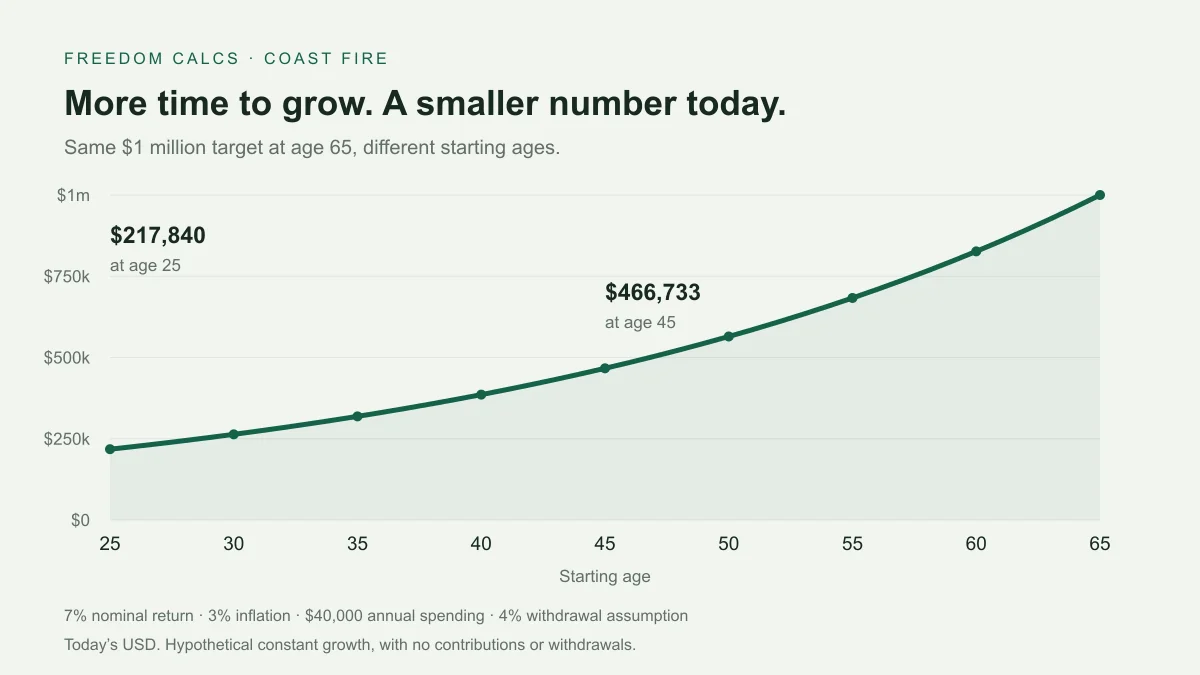
The table holds retirement age at 65, annual spending at $40,000, nominal return at 7%, inflation at 3%, and withdrawal rate at 4%. Each row represents a different starting age. Amounts are rounded to the nearest dollar and expressed in today’s purchasing power. No contributions or withdrawals occur during the growth period.
| Current age | Years to 65 | Coast FIRE number today |
|---|---|---|
| 25 | 40 | $217,840 |
| 30 | 35 | $263,555 |
| 35 | 30 | $318,862 |
| 40 | 25 | $385,777 |
| 45 | 20 | $466,733 |
| 50 | 15 | $564,679 |
| 55 | 10 | $683,179 |
| 60 | 5 | $826,546 |
| 65 | 0 | $1,000,000 |
Each amount links to the calculator. Set the current age to the age in that row and retain the assumptions above to reproduce it; the link does not automatically fill in the form.
The age-25 balance has 40 years to grow; the age-60 balance has only five. This is an illustration of time and compounding, not a savings benchmark for everyone of that age. Different household expenses can change the target substantially.
What Changes Your Number
Return assumptions
Holding the age-30 example constant, changing nominal return alone produces these thresholds. Inflation stays at 3%, retirement at 65, spending at $40,000, and withdrawal rate at 4%.
| Nominal annual return | Real annual return | Coast number today |
|---|---|---|
| 5% | 1.9417% | $510,126 |
| 7% | 3.8835% | $263,555 |
| 9% | 5.8252% | $137,840 |
A higher assumed return lowers the number, but entering it does not make it more likely to occur. Compare lower-return scenarios to understand how much of the plan depends on investment growth.
Retirement age and spending
For the same 30-year-old, changing retirement age to 55 raises the threshold to $385,777; age 60 gives $318,862; age 65 gives $263,555. These comparisons retain 7% nominal return, 3% inflation, $40,000 annual spending, and a 4% withdrawal rate. An earlier retirement also creates a longer withdrawal period, which this discounting formula does not evaluate.
Spending changes the number proportionally. Increasing the example’s annual budget from $40,000 to $50,000 raises the retirement target by 25%, to $1.25 million, and the age-30 Coast threshold to about $329,443. At $40,000 spending, changing the withdrawal assumption from 4% to 3.5% raises the retirement target to roughly $1.143 million and the Coast threshold to $301,205. A lower withdrawal rate changes the arithmetic; it still does not guarantee retirement success.
Continuing to contribute
Starting with $100,000 at age 30, the calculator’s $1,000 monthly contribution path first crosses the moving Coast threshold at age 49 years and 4 months. Contributions occur at month-end in today’s dollars, meaning their nominal amount rises with inflation. The other assumptions match the worked example.
At $500 per month, the projected retirement balance is about $818,776, and the threshold is not reached by 65. With no contributions, a below-threshold balance does not catch up simply by waiting under this constant-growth model: the balance and its changing threshold grow at the same rate. Additional saving, a different budget, or a different timeline changes the comparison.
What Coast FIRE Does Not Mean
Reaching Coast FIRE does not cover current living costs, establish early access to retirement accounts, or provide health insurance. A household budget and account-access plan remain necessary. Reducing work income can change both your spending capacity and your ability to respond to a shortfall.
Market risk: a smooth growth line hides losses and uneven returns. Once withdrawals begin, the order of returns also matters because selling assets during a decline can affect the remaining portfolio. This calculator estimates neither withdrawal survival nor the probability of meeting its target.
Inflation and changing expenses: the BLS CPI FAQ explains why broad inflation measures may differ from an individual household’s experience. Higher inflation reduces real growth when nominal return stays fixed. A larger future budget also raises the target, even if the investment balance follows the projected path.
The model does not calculate taxes, fees, Social Security benefits, pensions, or account restrictions. Include relevant costs in spending, assess fees when choosing a return input, and revisit the assumptions as circumstances change. The methodology’s limitations explain the calculation’s scope.
Frequently Asked Questions
How much money do you need to Coast FIRE?
There is no fixed amount. Divide portfolio-funded annual spending by the withdrawal-rate assumption, then discount that target over the time until retirement. In the age-30 example, $40,000 spending, 4% withdrawals, 7% nominal return, 3% inflation, and retirement at 65 give about $263,555 today.
Is $500,000 enough to Coast FIRE?
Under the table’s assumptions, $500,000 exceeds the threshold at age 45, about $466,733, but falls short at age 50, about $564,679. Both examples retire at 65 with $40,000 annual spending, a 4% withdrawal assumption, 7% nominal return, and 3% inflation. That comparison is model arithmetic, not a judgment that either plan is safe.
What is considered Coast FIRE?
A portfolio meets the model’s Coast condition when its projected growth without further contributions covers the later retirement target. Current expenses are funded separately. Someone who still saves can already be above the Coast threshold; someone funding current expenses from investments needs a model that includes those withdrawals.
Does a pension change the Coast FIRE number?
A pension can reduce the spending your portfolio must fund, depending on its amount, start date, duration, and inflation treatment. This Coast calculator does not model it. The FIRE Number Calculator allows continuing other income; it does not model a gap before a pension begins. Temporary wages and delayed benefits need separate treatment.
Is $3 million enough to retire at 55?
At a 4% initial withdrawal assumption, $3 million implies $120,000 in first-year portfolio withdrawals before taxes. Whether it supports a retirement beginning at 55 depends on spending, lifespan, market outcomes, account access, and other income. This is a full-retirement question; a Coast calculation alone cannot establish the answer.
How do I choose a Coast FIRE calculator?
Look for visible assumptions, an explicit inflation convention, and separate treatment of contributions and withdrawals. A reproducible example helps you check what the result means. Our calculator displays its inputs and methods openly, without claiming that one set of assumptions fits every household.
Sources and Model Notes
The tables use Freedom Calcs model 1.1.0, with the Coast formulas unchanged from version 1.0.0. Calculations retain full precision before display rounding. They are algebraic illustrations, independent of the historical withdrawal studies.
Bengen’s 1994 research and Cooley, Hubbard, and Walz’s 1998 study provide historical context for withdrawal assumptions. Past outcomes do not guarantee future results. The 4% used here is an adjustable example input, not a recommended rate or a probability of success.
Use the sources below to examine their scope. For the complete equations, contribution timing, and verification notes, read our calculation methodology.
Sources & further reading
- Federal Reserve Bank of St. Louis: constructing real interest rates
Supports the exact purchasing-power conversion, not a portfolio return forecast.
- William P. Bengen: Determining Withdrawal Rates Using Historical Data (1994)
Author-hosted research directory. Historical withdrawal analysis does not establish a safe rate for a future Coast FIRE plan.
- Cooley, Hubbard, and Walz: Retirement Savings (1998)
Author-hosted original study of historical US portfolios and withdrawal periods. Its results are not forecasts and do not validate this calculator.
- US Bureau of Labor Statistics: CPI questions and answers
Explains inflation measurement and why an individual household’s experience can differ.